

Kitchen Renovation in Malta and Gozo: What to Plan Before Works Start
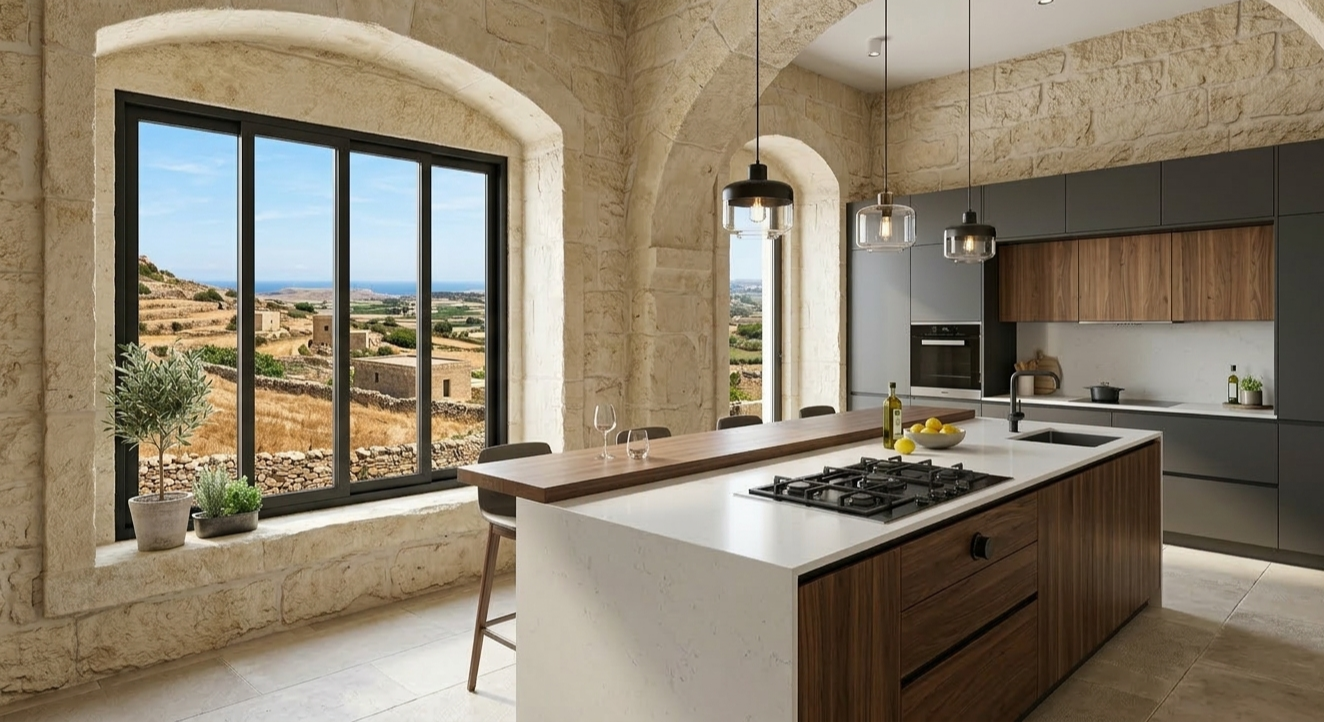
Kitchen renovation in a limestone house of character in Gozo with sea view and stone arches
Whether you’ve just bought a shell-form apartment or you’ve moved into a property with a kitchen stuck in the 1990s, the question is the same: where do I start?
In Malta and Gozo, outdated kitchens are extremely common. Many apartments are sold with original cabinetry from the 1980s or 2000s, poor ventilation, inadequate lighting, and layouts that made sense for a different way of living. Add the specific constraints of the Maltese climate ( heat, humidity, dust ) and a kitchen renovation here requires more thought than simply picking cabinet doors from a catalogue.
Here’s what you need to plan before any contractor or joiner is contacted.
Start with the layout, not the aesthetics
The most expensive mistake in any kitchen renovation is committing to a visual before validating the technical layout.
Before you choose colours, handles, or worktop finishes, you need to answer:
Where is the natural light coming from ? Is the current position of the kitchen taking advantage of it?
Is there a window above the sink, or can one be created?
Where are the existing water supply and waste pipes ? Are you willing to move them?
Where is the electrical consumer unit, and how many dedicated circuits does the kitchen currently have?
Is there an extraction duct, or does ventilation go through a recirculating filter only?
These questions determine what is actually possible in your space. The answers shape every decision that follows.
The extraction problem specific to Malta
Most apartments in Malta ( especially older ones ) have no dedicated extraction duct to the outside. The existing setup is either a recirculating hood (which filters but does not remove heat or humidity) or nothing at all.
In a Mediterranean climate where summer temperatures regularly exceed 35°C and kitchens generate intense heat, this is a real comfort and moisture problem.
Before your renovation, check:
Is there an external wall the extraction can vent through?
Is there a shared duct in the building that can be connected?
If neither is possible, what is the best recirculating solution available?
This decision affects where the hob can go, the height of the upper cabinetry, and the type of hood that will work in your space. It cannot be resolved after cabinetry is installed.
Gas or electric hob? The reality in Malta
This is a decision many expats get wrong, because they assume they can simply install an induction hob as they would back home.
In Malta and Gozo, the majority of properties ( including newer apartments ) are supplied with a single-phase electrical connection with a limited amperage. An induction hob alone draws between 7,000 and 10,000 watts. Add an electric oven, a dishwasher, air conditioning units and a water heater running simultaneously, and the consumer unit trips or the connection simply doesn’t have the capacity.
Upgrading to a three-phase supply is possible but involves ARMS (the Maltese energy regulator), an application process, and additional cost. It is not a quick fix.
The practical reality is this: gas remains the norm in Malta, and for good reason. It performs well, is not affected by power limitations, and is significantly cheaper to run for cooking.
The standard setup in most Maltese and Gozitan properties is a gas bottle ( typically a 12 kg cylinder) stored outside the dwelling, either on the terrace, in a dedicated outdoor cabinet, or in a ventilated ground-floor store. A gas pipe runs through the wall to connect to the hob.
Before your renovation, confirm:
Is there an existing gas connection to the kitchen, and where does it enter the room?
Is the gas bottle position compliant with current regulations (ventilated, accessible, away from ignition sources)?
If you want to change the hob position, can the gas pipe be re-routed ?
If you genuinely want induction, has an electrician confirmed your supply can support it?
This decision directly affects cabinetry layout, the position of the hob cut-out, and the extraction specification above it.
Electrical planning: kitchens need dedicated circuits
Even with a gas hob, the electrical load in a modern kitchen is significant.
A contemporary kitchen typically requires separate dedicated circuits for: the electric oven, the fridge, the dishwasher, the washing machine if located in the kitchen, and the microwave.
Plugging everything into a single circuit is a fire risk and will trip your consumer unit repeatedly.
Before renovation, have an electrician assess:
The current number of kitchen circuits
The capacity of the consumer unit
Whether chasing new cables into walls is possible before plastering
If your renovation involves opening walls or floors for any reason, that is the moment to upgrade the electrical layout, not after.
Water and waste: get it right before the tiles go down
Plumbing is the one thing you absolutely cannot change cheaply once tiles are laid.
The position of the sink, the dishwasher connection, and any under-counter water filtration system must be determined before tiling begins. Waste pipes in Maltese apartments are often surface-mounted or cast into the screed. Moving them later means breaking up the floor.
Sink: one basin or two?
A single large basin (60 cm or more) works well for most households and leaves more worktop space. A double basin is useful if you hand-wash frequently or don’t have a dishwasher. The choice affects the minimum cabinet width beneath it, the worktop cut-out, and the tap position.
Undermount sinks have become popular for their clean aesthetic and easy worktop cleaning but they require a solid worktop material (stone, quartz, or porcelain) and cannot be fitted to laminate or HPL without special framing.
Dishwasher: space and connection
A standard dishwasher is 60 cm wide and requires a cold water inlet, a waste outlet, and a dedicated electrical socket inside the cabinet. A slimline model (45 cm) is a practical solution in compact kitchens. Both need to be positioned adjacent to the sink for efficient waste connection. If no dishwasher connection currently exists, this pipe work must be roughed in before cabinetry is installed.
Mixer tap: practical decisions first
The style of mixer tap affects what else can be fitted at the sink. If you want a pull-out spray tap, a boiling water tap, or a separate filter tap alongside the main mixer, each requires its own deck hole in the sink or worktop. These holes cannot be added after installation without risk of cracking. Decide upfront and check under-sink space, as boiling water taps require a separate tank unit below.
Kitchen layout: the work triangle and circulation space
Before thinking about cabinetry styles or appliance brands, the layout needs to be validated against a simple but essential principle: the work triangle.
The work triangle connects the three core zones of any kitchen : the hob, the sink, and the refrigerator. These are the three points you move between constantly when cooking. If they are too far apart, the kitchen is tiring to use. If they are too close or poorly aligned, they create congestion when two people are in the kitchen at the same time.
A well-designed work triangle:
Has each side between 120 cm and 270 cm
Is not interrupted by a circulation route or a door swing
Places the sink and hob on the same run of worktop, or on adjacent runs, never on opposite walls with a walkway between them
In Maltese apartments, kitchens are often long and narrow, or arranged in an L-shape. Both configurations can work well, but only if the triangle is validated before cabinetry positions are locked in.
The kitchen island: when it works and when it doesn’t
An island is one of the most requested features in kitchen renovations and one of the most frequently impossible to execute correctly in the available space.
An island requires sufficient clear circulation space on all sides to function safely and comfortably. The minimum clearances are:
90 cm on the side facing the main run of cabinetry : the absolute minimum for one person to work and open drawers or the oven door
100 to 110 cm on that same side if two people will regularly cook together
90 cm on all other sides for comfortable passage
This means a kitchen needs to be at least 3.8 to 4 metres wide to accommodate even a modest island of 80 cm depth without counting the wall cabinets on either side.
In practice, many Maltese kitchens simply do not have this width. Installing an island anyway creates a kitchen that looks good in photos but is frustrating to use daily blocked drawers, restricted oven access, and a constant feeling of being cramped.
Alternatives when an island isn’t feasible:
A peninsula : an extension of the existing run attached to a wall on one side, requiring clearance on three sides only
A moveable kitchen trolley : flexible, no fixed plumbing or electrical, can be stored when not needed
A wider breakfast bar attached to a wall : provides the social and prep surface function without occupying floor space
Always verify the available dimensions on a scaled floor plan before committing to an island. A 10 cm error in estimation is the difference between a kitchen that works and one that doesn’t.
Storage: the biggest underestimated need
Expats consistently underestimate how much kitchen storage they need, especially apartments where there is no separate utility room or pantry.
In Maltese kitchens, storage is often designed with minimal upper cabinets, low ceilings, and no tall unit provision. Before designing your new kitchen, list what you need to store:
Everyday crockery and glassware
Small appliances (stand mixer, blender, coffee machine, toaster)
Dry goods and pantry items
Cleaning products and recycling
Ironing board and household essentials if there is no utility room
Then design the cabinetry around the actual storage requirement, not the other way around.
A tall larder unit, a pull-out pantry, or deep drawer stacks under the worktop can completely transform the functionality of a small kitchen.
Worktop material and the Maltese climate
Malta’s climate is hard on certain materials. Direct sun exposure through south or west-facing windows will fade and warp solid wood worktops over time. High summer humidity can affect untreated natural stone. And the combination of heat, steam, and sea air accelerates the deterioration of low-quality finishes.
Materials that perform well in this climate:
Laminate (postforming) : the most affordable option and still widely used in Malta. Modern laminate has improved significantly and can mimic stone or wood convincingly. It is moisture-resistant on the surface but vulnerable at cut edges and joins if not properly sealed. Not compatible with undermount sinks. A practical choice for budget-conscious renovations.
Compact laminate / HPL : thicker and more durable than standard postforming laminate. Fully waterproof on all faces, resistant to heat and scratches. A solid mid-range option, compatible with most sink types except undermount.
Quartz composite : good performance across the board, wide range of aesthetics, and lower maintenance than natural stone. Avoid prolonged direct sun exposure on lighter colours.
Porcelain worktops extremely durable, heat and UV resistant, and very low maintenance. More expensive to supply and install, but increasingly popular in Malta for good rea—son.
Natural stone (granite, marble) : beautiful but requires sealing and regular maintenance, especially in high-humidity kitchens near the sea.
Solid timber looks stunning in renders. In a Maltese kitchen with a sea view and no air conditioning running continuously, it requires serious ongoing care.
The splashback: not an afterthought
The area between the worktop and the upper cabinets must be coordinated with the worktop before tiles are ordered. Options include ceramic or porcelain tiles, large-format porcelain slabs, worktop material extended upward, painted plaster, or glass panels.
Important: the splashback behind a gas hob must be non-combustible. Tiles, stone, and glass all comply. Some painted finishes and timber cladding do not.
Lighting: the most overlooked part of kitchen design
Most older Maltese kitchens have a single ceiling light. It creates shadows on every work surface, makes cooking uncomfortable in the evening, and makes the room feel smaller than it is.
A functional kitchen needs at least three layers of lighting:
Ambient : general ceiling lighting for the room
Task : under-cabinet LEDs directly above the worktop
Accent : inside glass cabinets, above open shelving, or a pendant over a kitchen island
Under-cabinet lighting must be planned before cabinetry is ordered — the profile, the switch logic, and the cable routing all need to be integrated into the design. Retrofitting them afterwards is messy and rarely looks clean.
The sequence that avoids expensive mistakes
Define layout and confirm what can/cannot move (plumbing, extraction, gas, structure)
Plan electrical circuits and lighting before any wall is plastered or tiled
Finalise appliance selection before cabinetry is measured and ordered
Confirm worktop material before splashback tiles are chosen
Order cabinetry and tiles in parallel both have lead times of 4 to 8 weeks in Malta
Install in the right sequence: electrical first, then plumbing rough-in, then floor screed if needed, then wall tiles, then units, then worktop, then appliances
Reversing any of these steps creates rework. Rework costs money and time.
Whether it’s a shell form or a 20-year-old kitchen
The planning process is the same.
In a shell form, you have total freedom which means you carry total responsibility for every decision made upfront.
In an existing apartment with an outdated kitchen, you have constraints ( existing pipes, existing apertures, existing ceiling heights ) but the same technical questions still apply before you commit to a design.
In both cases, the renovation works only as well as the preparation behind it.
How I can help
Renovating or replacing a kitchen in Malta involves a series of technical decisions that need to be made in the right order, before any contractor starts work.
My kitchen design service covers:
Layout validation and work triangle optimisation
Island or peninsula feasibility based on your actual dimensions
Positioning of all appliances and kitchen elements
Material selection for worktops, splashback and finishes adapted to the Maltese climate
Electrical plan: circuits, sockets, lighting zones
Plumbing plan: sink, dishwasher, gas connection
From there, I visit the relevant showrooms with you ( or on your behalf ) to specify each element and finish in detail. This allows us to establish an accurate, comparable final quote, with no vague estimates and no surprises once works begin.
