

Bathroom Renovation in Gozo: What Foreign Owners Get Wrong
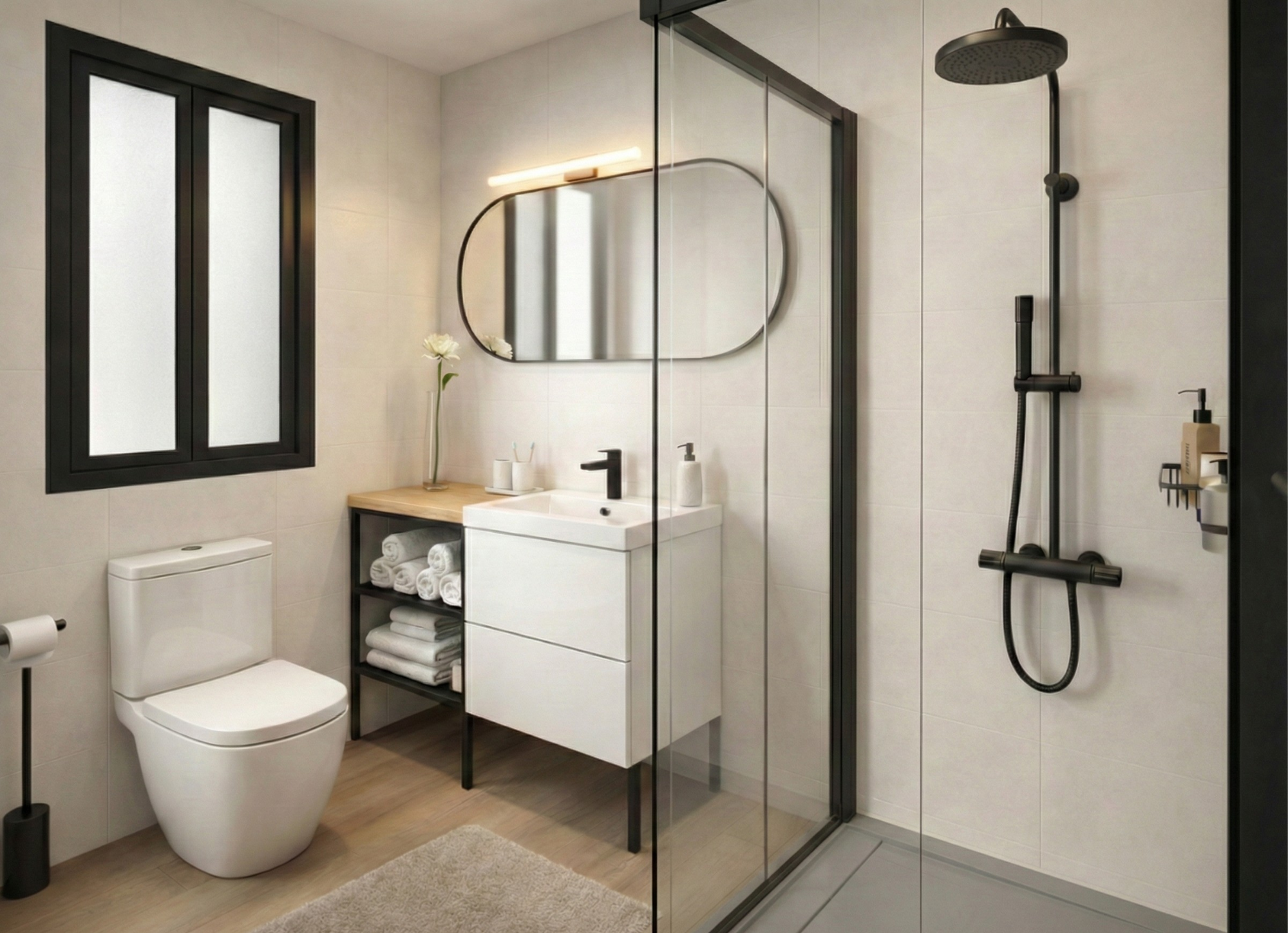
You found your dream property in Gozo. You have a vision for your bathroom: clean lines, a walk-in shower, maybe a freestanding bath, definitely good water pressure. You have a budget. You have Pinterest boards. What could go wrong?
Quite a lot, as it turns out. With over twenty years of experience in residential renovation across Europe, and having worked closely with foreign owners on projects in Gozo, I see the same mistakes repeated, regardless of nationality, budget, or level of experience with construction projects. The island has its own rules, and if you do not know them going in, your bathroom renovation will cost more, take longer, and deliver less than you expected.
Here is what you need to know before you start.
Assuming the floor build-up works like back home
This is the single biggest technical misunderstanding I encounter. In most of Europe, bathroom floors are finished with a poured self-levelling screed, giving you a perfectly flat, continuous substrate ready for tiles. In Gozo, the standard method is a semi-dry sand and cement bed, laid by hand, compacted, and finished manually by the tiler.
This is not an inferior method. Maltese tilers are highly skilled and the results can be excellent. But the technique is different, and it has direct consequences for your project:
- The bed height is less predictable. A semi-dry bed typically sits between 30 and 50 mm, but the exact finished level depends on the tiler. If you are planning flush thresholds between rooms, or a level-access shower tray, you need to discuss this explicitly with your contractor before work begins, not after.
- Waterproofing sits beneath the bed, not above it. This means the tanking layer is applied to the structural slab before the bed is laid. If your contractor skips or rushes this step, you will not know until damp appears months later, often in the ceiling of the room below.
- Underfloor heating requires coordination. Electric heating mats can be embedded in the bed, but the depth and the thermal properties of a sand and cement build-up are different from a flowing screed. If you want underfloor heating in your bathroom, specify it at the very start and confirm your contractor has experience laying it correctly in this system.
2. Ignoring the water quality problem
Gozo has hard water. Very hard water. The island relies on a combination of reverse osmosis treatment and groundwater, and the mineral content is high enough to cause real damage to bathroom fixtures if you do not address it.
Limescale builds up rapidly on taps, showerheads, glass screens, and inside boilers and pipes. Fixtures that look pristine on installation day can appear neglected within a year if the water is not treated. This is not an aesthetic complaint: scale build-up reduces the lifespan of your boiler, clogs shower fittings, and can void manufacturer warranties.
The solution is a whole-house water softener, sized correctly for your property. For most family homes, a unit treating 25 litres per minute is sufficient. If you want drinking-quality water at the kitchen tap as well, you can add an under-sink reverse osmosis filter as a separate point-of-use system.
If you are renovating a shell form property or planning a complete bathroom overhaul, the best moment to install the softener is before your bathroom fixtures go in, because the pipework installation is cleaner and the plumber can plan the bypass loop properly from the start.
Do not treat the water softener as an optional upgrade. On Gozo, it is as essential as the boiler itself.
1 - Choosing tiles before understanding the constraints
Foreign owners often arrive with very specific tile ideas, sometimes already purchased or reserved back home. This creates problems on several levels.
Logistics. Malta is an island. Shipping tiles from Italy, Spain, or France adds cost, lead time, and fragility risk. A single broken pallet can delay your entire bathroom by weeks. If you are importing tiles, build at least 15% extra into your order to cover cuts and breakages, and plan your project timeline around the shipping schedule, not the other way around.
Format compatibility. Very large format tiles (anything above 120 x 60 cm) require a perfectly flat substrate and a skilled tiler who is comfortable with the format. Not every contractor on the island works regularly with large slabs. If you want 160 x 320 cm porcelain, confirm your tiler's experience before you commit to the tile.
Grout joint and layout decisions. A common mistake is selecting a tile and leaving all layout decisions to the tiler on site. The tiler will default to the fastest, most economical approach. If you want a specific joint width, a brick-bond offset, a book-match on a stone tile, or a centred layout on a feature wall, these decisions must be communicated in writing before work starts. Once tiles are on the wall, nothing can be changed without full removal.
Local sourcing. Malta has good tile showrooms with competitive ranges. Before importing, explore what is available locally. Lead times are shorter, you can see the material in person, and any replacements needed during the project are achievable without weeks of delay.
2 - Underestimating the ventilation requirement
Gozo is warm and humid, particularly in summer. Bathrooms without adequate ventilation develop mould very quickly, especially in interior rooms with no opening window.
The Maltese planning and construction culture does not always prioritise mechanical ventilation in the same way northern European practice does. Extraction fans are frequently installed as an afterthought, using undersized units vented through short runs, sometimes into a ceiling void rather than to outside air.
If your bathroom has no opening window, or if it opens onto an internal courtyard with limited air movement, you need a properly specified mechanical extract ventilation unit with a ducted run to the exterior. This should be planned at first fix stage, before partitions and ceilings are closed in. Retrofitting a proper ventilation system after finishes are complete is expensive and disruptive.
For bathrooms with a window, consider also whether summer humidity and winter condensation on cold tiles warrants a supplementary extract fan regardless. A small investment at the right moment avoids significant remedial work later.
3 - Confusing the contractor's role with the designer's role
This is perhaps the most costly misunderstanding of all, and it is not specific to bathroom renovations.
In Gozo, a good contractor will build what you show them. They will source materials if you ask them to, and they will make decisions on your behalf if you do not provide guidance. But a contractor is not an interior designer. Their job is execution, not space planning, proportion, or aesthetics.
4 - What this means in practice:
- If you do not specify the exact position of your shower drain, the contractor will place it where it is easiest to run the pipe.
- If you do not specify the height of your wall-hung vanity unit, it will be fixed at the standard height the fitter uses for everyone.
- If you do not provide a detailed tile layout drawing, the tiler will start from the most convenient corner.
- If you do not specify which wall the shower niche goes on, and at which height, it will be positioned based on the plumber's pipework, not your reach height or your aesthetic intent.
Every one of these decisions, made without your input, can produce a bathroom that is perfectly functional and deeply unsatisfying. The answer is not to micromanage your contractor on site. It is to produce a clear, complete set of drawings and specifications before work begins, so that every decision is documented and agreed in advance.
This is what an interior designer does. Not choose the tiles for you, though that is part of it, but translate your vision into a language the contractor can build from, and catch the conflicts before they become expensive problems.
5 -Planning the budget without a contingency
Bathroom renovations in Gozo consistently run over initial estimates, for reasons that are largely predictable once you understand the context.
Shell form properties in particular frequently reveal hidden problems once work begins: drainage outlet positions that do not match your intended layout, slab levels that require adjustment, or first-fix electrical and plumbing routes that conflict with your partition plan. None of this is visible during a viewing, and most of it cannot be priced until demolition begins.
A realistic contingency for a full bathroom renovation in Gozo is 20% of your total budget, set aside and not touched unless needed. If your project runs cleanly, you will have money left over. If it reveals problems, you will be able to address them properly rather than cutting corners on the finish.
6 - Where to start
If you are planning a bathroom renovation in Gozo and you are not based on the island full-time, the most valuable thing you can do before contacting a contractor is to work with a designer to produce a proper brief and set of drawings. This gives every contractor you approach the same information, makes quotes genuinely comparable, and protects your project from the most common and most avoidable mistakes.
Gozo is a remarkable place to own property. With the right preparation, your renovation can deliver exactly what you imagined.
