

Outdoor Spaces in Gozo: How to Make the Most of Your Terrace
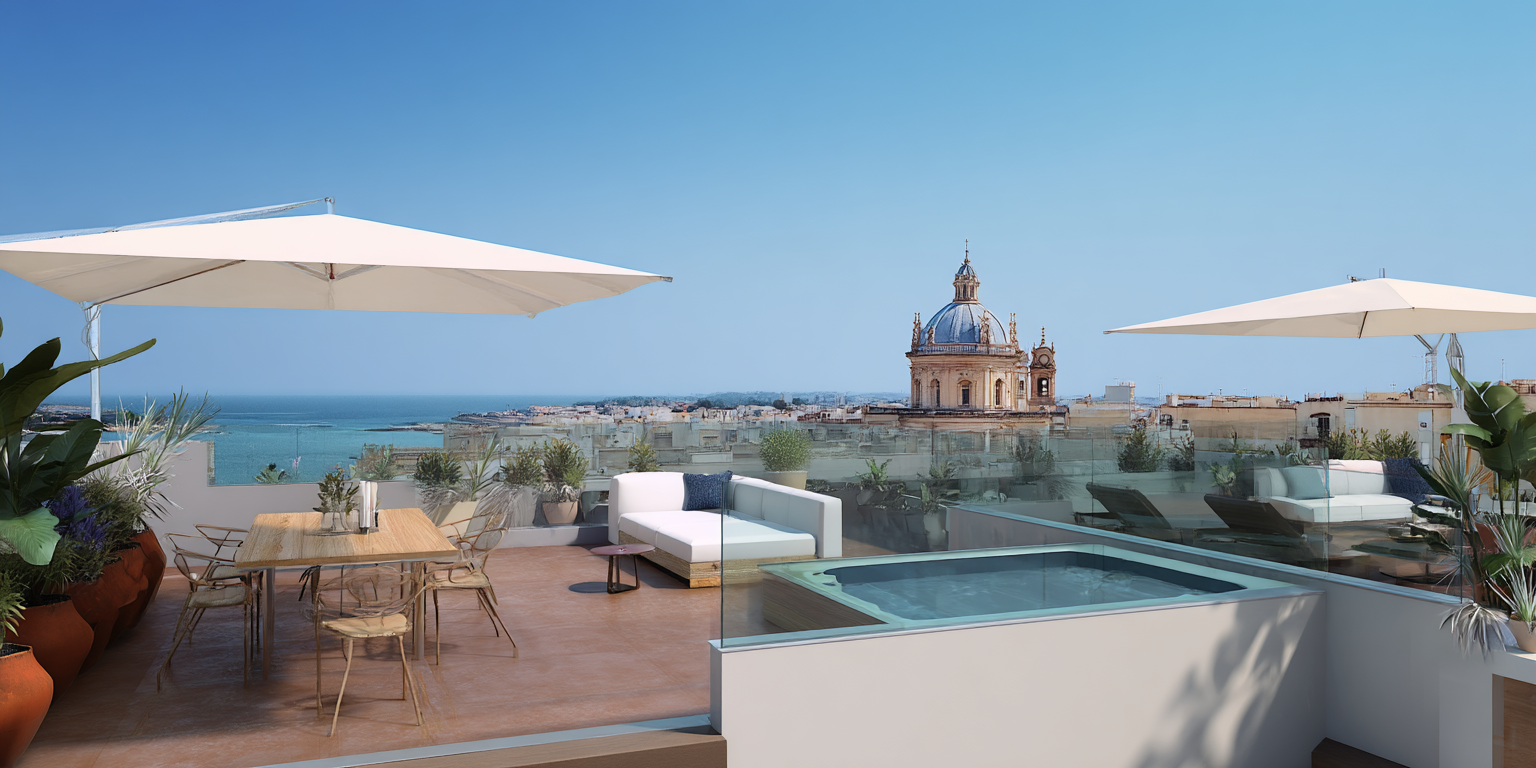
Rooftop terrace design in Gozo with sea view and outdoor living space
In Gozo, outdoor space is not a bonus. It is one of the main reasons people move here.
Whether it is a rooftop terrace above an apartment in Marsalforn, a ground-floor courtyard in an old town house in Victoria, or a wide balcony overlooking the countryside, outdoor space in Gozo has qualities that are difficult to find in most European cities: light, silence, views, and warmth for most of the year.
But turning that space into something genuinely usable, comfortable, and beautiful requires planning. The climate is more demanding than it looks, the constraints are real, and the choices you make in materials and layout have consequences that last decades.
Here is what to think about before you start.
Here is what to think about before you start.
Start with the constraints
Before anything else, you need to understand what you are allowed to do.
Before any contractor is contacted, the technical work needs to be done. This means a finalised floor plan, electrical drawings, lighting design, plumbing layout, and a complete finishes schedule covering floors, walls, joinery, kitchen, and bathrooms.
Most expats underestimate this phase or skip it entirely. That is the single most common cause of delays and budget overruns later in the project.
If you are working with a designer, this phase takes 4 to 8 weeks depending on the complexity of the project and the speed of your own decision-making. If you arrive at a contractor without this documentation, you are not ready to start (regardless of what the contractor tells you).
In Malta and Gozo, any structural addition to an outdoor space( a pergola, a fixed canopy, a raised platform, a permanent screen ) may require a planning permit from the Planning Authority. This is not always obvious, and the rules depend on the type of property, its location, and whether the addition is considered a fixed or temporary structure.
As a general principle, open trellis structures (pergolas without solid roofing) are treated more favourably than fully covered structures. But in practice, the distinction is not always straightforward, and any work that changes the external appearance of a building or adds a structure to a roof terrace should be checked with a perit before starting.
A few specific situations that require particular attention:
Apartment roof terraces. In apartment buildings, the roof terrace may belong to the top-floor unit, but structural additions affect the entire building. Any permanent structure at roof level needs to comply with the building height limits set in the local plan and may require approval from co-owners.
Properties in Urban Conservation Areas (UCAs). Gozo has a significant number of buildings in designated conservation areas, particularly in and around Victoria and the older villages. In these areas, any visible change to a facade or roof is subject to additional scrutiny. Materials, colours, and forms need to respect the local character.
Farmhouses and rural properties. Properties outside the development zone (ODZ) are subject to rural planning policies that significantly limit what can be added. A perit familiar with Gozitan planning regulations is essential before any external work on a rural property.
The rule of thumb: consult a perit before spending a euro on design or materials for any structural outdoor addition.
The climate: what it really means for materials
Gozo's climate is Mediterranean, but it is also coastal. The combination of heat, UV exposure, humidity, salt air, and periodic weather events is harder on materials than most people realise when they first arrive.
Salt air. Gozo is a small island. Even properties that are not directly seafront are affected by salt-laden air, particularly in winter when winds are stronger. Salt accelerates corrosion on metal, degrades painted surfaces, and attacks untreated timber over time.
UV intensity. The sun in summer is significantly more intense than in northern Europe. Materials that look beautiful in a showroom can fade, crack, or warp within a few years if they are not suited to prolonged UV exposure.
Heat accumulation. Dark-coloured surfaces on terraces exposed to full sun can reach temperatures of 50 to 70°C in summer, making them unusable without footwear and uncomfortable for sitting near. Light colours are not just an aesthetic choice, they are a thermal one.
Humidity cycles. Gozo has dry summers and more humid winters. Materials that expand and contract significantly with moisture changes, including some natural timbers, can develop problems over time.
The Sirocco (Xlokk). Malta and Gozo experience around 30 episodes a year of the Sirocco, a hot, dusty wind originating over the Sahara, known locally as the Xlokk. It arrives most frequently in spring and autumn, but can occur at any time of year. The wind carries fine red Saharan dust particles northward across the Mediterranean. When it coincides with rain, the precipitation deposits this dust on every surface, producing what the Maltese call xita tal-hamrija, "blood rain." The result is a red film on terrace tiles, furniture, fabric cushions, and anything left outside. Materials with textured surfaces, open weaves, or porous finishes accumulate it more than smooth, sealed ones. Factor this into your choice of surfaces and your maintenance expectations.
Wind. The wind in Gozo is genuinely strong and should be taken seriously in any outdoor design. The dominant winds come from the north-west to north-north-west. The Grégale, a powerful and cold north-easterly, is particularly significant in winter and can reach gale force. Both can be violent. Fabric shade sails and textile canopies that are not specifically engineered for high-wind environments will not survive the Gozitan winter intact. Freestanding parasols, however weighted, will be thrown over. Any shading or screening structure needs to be properly anchored and designed for wind resistance, not just sun protection.
Flooring: which materials work and which don't
Porcelain tiles are the most reliable choice for outdoor terraces in Gozo. They are UV-stable, do not absorb moisture, are unaffected by salt air, and are available in formats that mimic stone or timber without the maintenance requirements. Anti-slip ratings matter: always specify outdoor porcelain with a high wet anti-slip coefficient, particularly around pools and in areas exposed to rain. The main limitation of porcelain is heat accumulation. Light colours are strongly preferable for terraces in full sun. Dark porcelain on a south-facing terrace can become genuinely painful to walk on barefoot in July.
Natural stone ( limestone, travertine, basalt ) has a beautiful quality in the Gozitan context and ages well visually. Local Maltese limestone is a logical choice that connects the outdoor space to the local architectural character. The practical considerations: natural stone is porous and needs sealing, particularly in areas exposed to rain and sea air. Travertine in particular requires periodic maintenance to remain water-resistant. Unsealed, it stains and absorbs moisture.
Composite decking (WPC) performs well in coastal Mediterranean climates. It does not rot, does not require annual treatment, and is not affected by salt air. The main caveat is heat: dark composite decking in full sun can become very hot. Light-coloured composite in shaded or partially shaded areas is a practical and visually warm option. Avoid solid timber decking without specific coastal treatments, it requires significant ongoing maintenance in this climate and will grey, crack, and split without it.
Concrete screed finishes are practical and cost-effective, particularly for large terraces. A polished or brushed cement finish holds up well and can be very contemporary in appearance. It heats up in the sun but less extremely than dark porcelain. It needs sealing and periodic reapplication to remain water-resistant.
Shade: not optional
This point cannot be overstated. A terrace without shade in Gozo is unusable from May to October between 11am and 4pm.
The approach to shade defines both the aesthetics and the usability of the space.
Pergolas. An open timber or aluminium pergola with a climbing plant is the most integrated solution in the local context. Wisteria, bougainvillea, and jasmine all thrive in Gozo's climate and create natural, seasonal shade. The limitation: climbing plants take several years to provide dense coverage, and in the first years the shade is partial.
Shade sails and canopies. Tensioned fabric shade sails are flexible, affordable, and highly effective. They can be rigged seasonally (removed in winter to reduce wind load and UV degradation) or designed as more permanent installations. Material quality matters significantly: cheap shade cloth degrades quickly in UV. Specify UV-resistant, breathable fabric designed for Mediterranean climates.
Aluminium pergolas with adjustable louvres. These systems allow control of light and rain without the visual weight of a full canopy. They are more expensive than a fixed structure, require planning assessment, and need to be properly anchored given Gozo's wind exposure in winter.
Outdoor blinds and screens. Vertical screens, retractable blinds, and fixed perforated panels can control both sun and wind without a roof structure. Useful on balconies and for privacy as much as shade.
Privacy and wind
In Gozo, outdoor spaces are often overlooked. Terraces in apartment buildings face neighbouring properties. Ground-floor courtyards open onto narrow streets. Rooftop spaces overlook other rooftops.
Privacy screens need to be designed carefully. A solid parapet wall solves privacy but blocks views and air circulation. A perforated or open screen maintains airflow while creating visual separation. Planters with dense vegetation can achieve privacy gradually but require irrigation and ongoing care in the dry summer months.
Wind is also a real factor, particularly at roof level and in exposed coastal positions. Gozo's winter winds are not negligible, and a terrace that is perfectly comfortable in summer can be difficult to use from November to February without windbreaking. Glass balustrades and screens are effective but need to be specified for wind load and salt air resistance. Aluminium framing with marine-grade finishes is preferable to painted steel in coastal positions.
Furniture and fittings: what survives the climate
Not all outdoor furniture performs equally in Gozo's conditions.
Aluminium is the most reliable material for outdoor furniture frames in coastal Mediterranean climates. It does not rust, does not require painting, and handles UV and salt air well. Powder-coated aluminium in light colours is preferable to dark, which absorbs heat.
Stainless steel can work but requires marine-grade specification (grade 316) in coastal positions. Standard grade 304 stainless will rust in salt air environments over time.
Teak and other dense tropical hardwoods perform well outdoors if properly maintained. Untreated, teak will silver and dry out. Treated annually with teak oil, it can last many years. It is a beautiful material but a commitment.
Woven resin (synthetic rattan) handles UV and moisture well if quality is adequate. Cheap synthetic rattan degrades visibly within a couple of years in full sun. Specify UV-stabilised materials from suppliers who can confirm outdoor suitability.
Fabric cushions and upholstery must be in outdoor-grade fabrics (solution-dyed acrylic, Olefin, or similar). Indoor fabrics used outdoors will mould in winter and bleach in summer within a single season.
Materials to avoid outdoors in Gozo
Some materials that look good in a showroom or work perfectly well in a northern European garden simply do not survive Gozo's combination of UV, salt air, Sirocco dust, and winter wind. Knowing what to avoid saves time, money, and frustration.
Painted or coated steel corrodes rapidly in salt air. Even with annual repainting, rust will appear within a few years. Avoid entirely in any coastal position.
Standard stainless steel (grade 304) not marine-grade. Will rust visibly in salt air environments within 2 to 3 years.
Bamboo splits and deteriorates quickly in the cycle of dry summers and humid winters combined with UV intensity. Not suitable for outdoor use in this climate.
Untreated softwood (pine, spruce) rots rapidly. No place on a Gozitan terrace.
Low-quality synthetic rattan yellows, becomes brittle, and disintegrates in full UV exposure within one to two seasons. Only UV-stabilised, quality-certified products are worth considering.
Plastic furniture not UV-stabilised yellows and becomes brittle quickly. The cheap white garden chairs widely available will not last.
Outdoor rugs and floor textiles this deserves particular emphasis. Outdoor rugs look appealing in design references but are genuinely impractical in Gozo. Red Sirocco dust settles into textile fibres and is almost impossible to remove completely. Wind displaces and damages them. They trap moisture and create mould conditions. Most locals do not use them, and for good reason. Stick to hard, sealed surfaces for all terrace flooring.
Dark-coloured composite decking or porcelain not a material failure exactly, but a usability one. Dark surfaces in full sun reach temperatures that make the terrace unusable barefoot in summer. Light or mid-tones are strongly preferable.
Parasols: choosing the right one for Gozo
A parasol is one of the most popular ways to create shade on a terrace. It is also one of the most frequently underspecified pieces of outdoor equipment, and one of the most common casualties of the first winter.
The fundamental rule in Gozo: a parasol that is not properly weighted will be thrown over by the wind, no matter how good the base looks. A parasol that falls on furniture, tiles, or a person is not just an inconvenience — it is a safety issue.
Base weight recommendations by parasol diameter:
2 m parasol: minimum 40 kg base
2.5 to 3 m parasol: minimum 60 to 80 kg base
3.5 m and above: minimum 100 kg base, with ground anchoring strongly recommended
These are minimums for a sheltered position. On an exposed rooftop or a terrace with no wind break, increase these figures significantly or choose a wall-mounted or pergola-integrated solution instead.
Wheels are not optional. A base of 60 to 100 kg cannot be moved without wheels. A wheeled base allows you to reposition the parasol, store it in winter, and move it indoors or under cover quickly when a storm is forecast. Any parasol base without wheels in this weight range is unusable in practice.
Close the parasol in wind. Even a correctly weighted parasol must be closed when wind picks up. A parasol left open in a Grégale will not survive it. This is not a product failure, it is a use requirement. Plan where you will close and store the parasol each time you leave the terrace unattended.
Storage: the overlooked essential
This is where most outdoor terrace designs in Gozo fail.
Cushions, mattresses, parasols, and any textile outdoor element need to be stored during winter and brought inside whenever heavy rain or strong wind is forecast. In practice, if storage is not planned from the start, cushions get left out, get soaked, develop mould, and are replaced every couple of years. The terrace becomes a source of frustration rather than pleasure.
A purpose-built outdoor storage box or a dedicated cupboard accessible from the terrace should be considered a non-negotiable part of the design — not an afterthought. Size it generously. If the terrace has a sofa with four or six seat cushions plus back cushions, plus a dining set, plus parasol covers, the volume adds up quickly.
Waterproof storage boxes in UV-stabilised resin or powder-coated aluminium work well and can double as occasional seating or side tables. A built-in storage bench at the edge of the terrace is another clean solution.
Maintenance: the honest reality
There is a reason most Gozitan locals do not invest heavily in their terraces. The combination of Sirocco dust, salt air, and wind creates a maintenance burden that few people anticipated when they designed the space.
Terrace surfaces need regular sweeping and washing, particularly after Sirocco episodes, which leave a fine red film on everything. Smooth, sealed surfaces (porcelain, sealed natural stone) are significantly easier to clean than textured or porous ones.
Metal furniture and fittings need an annual inspection for any signs of corrosion, with prompt treatment before it progresses.
Timber elements need checking and retreating annually before summer.
This is not a reason to not invest in your outdoor space. A well-designed terrace in Gozo is one of the great pleasures of living here. But it is a reason to design for low maintenance from the start: choose sealed over porous, smooth over textured, aluminium over steel, and plan your storage before anything else.
Green elements: what grows in Gozo
Planting on a Gozo terrace needs to account for the long dry summer, the salt air in coastal positions, and the intense summer sun.
Drought-tolerant Mediterranean species work best: rosemary, lavender, olive, agave, yucca, and succulents all thrive with minimal irrigation and handle salt air without difficulty. Citrus trees in large pots are a productive and visually strong choice. Bougainvillea grows effortlessly here and provides dense colour and structure on walls and trellises.
Banana trees can grow in Gozo and create an immediately tropical atmosphere, but their large leaves shred in strong wind. They only work in a sheltered courtyard or a well-protected corner of a terrace, not in an exposed position.
Large pots and planters work better than shallow containers. The larger the soil volume, the more resilient the plant to heat and drought. Irrigation is not optional for anything beyond the most drought-tolerant species : a basic drip system with a timer makes summer management straightforward.
The outdoor space as part of the design
The outdoor space does not exist in isolation. It connects to the interior through the glazing, the flooring material, the ceiling heights, and the way views are framed or blocked.
The best results come from designing indoors and outdoors together: continuing the flooring level from inside to outside where possible, aligning the outdoor ceiling height with the interior, and choosing materials that complement rather than contradict the interior palette.
This is particularly relevant in Gozo, where properties often have significant outdoor space and where getting the relationship between inside and outside right defines the character of the whole home.
How I can help
Outdoor spaces are part of my full design mission service. I work with you from the initial layout through material selection, shading strategy, planting concept, and furniture specification, all coordinated with the interior design and the technical documentation.
If you are planning to develop an outdoor space as part of a wider renovation, or if your terrace or courtyard is the starting point for a project, I would be glad to help you think it through.
